
Identify raccoon footprints and travel routes
Raccoon Tracks
Learn how hand-like raccoon footprints in mud, snow or dust can identify repeated travel routes near trash cans, decks, crawl spaces, roofs, ponds and other areas around a property.
Licensed and insured • Residential and commercial service • Serving Virginia since 2008
Footprints can reveal travel routes and repeated activity
What Raccoon Tracks Can Tell You
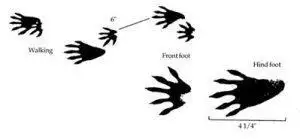
Raccoon tracks are distinctive because the toes are long and narrow, creating a hand-like appearance. Both the front and rear feet normally show five toes, but the hind print is longer and may resemble a small human foot.
Tracks are easiest to see in mud, snow, dust, soft soil or around wet surfaces. Their location can be more useful than the print alone. Repeated tracks near trash cans, decks, crawl-space vents, roof access routes, ponds or sheds may show where raccoons travel or enter a structure.
A single print may only indicate that a raccoon passed through. Multiple fresh tracks, droppings, damage or repeated nighttime activity suggest a more established problem.
Front prints, rear prints and walking patterns
How to Identify Raccoon Footprints
Front raccoon tracks
Front prints are smaller and more compact, with five long toes spreading forward from a rounded palm area.
Rear raccoon tracks
Rear prints are longer through the heel and often look more like a narrow human footprint with five toes.
Tracks often appear in pairs
When walking, a rear foot may land close to or partly overlap a front print, creating paired or staggered track patterns.
Claw marks may be visible
Fine claw impressions can appear beyond the toes when the surface is soft enough to capture detail.
Tracks near a structure can help locate entry routes
Raccoon Tracks Around Homes and Buildings
Tracks near a foundation vent, crawl-space door, downspout, deck post or roof-access tree may identify the route a raccoon uses repeatedly. Muddy prints can also appear on siding, gutters, flat roofs or around attic and chimney access points.
Photograph tracks before rain, traffic or cleanup destroys them. Include a ruler, coin or another common object for scale without touching the print.
Do not approach the animal to confirm the tracks
Tracks are useful evidence, but they are not a reason to follow, corner or handle a raccoon.
Keep children and pets away from active travel routes and document the location safely.
Use footprints with other evidence
How Raccoon Tracks Are Evaluated
- Confirm the print pattern. Toe count, shape, size and the relationship between front and rear prints are considered.
- Note the surface and freshness. Mud, snow and dust preserve different levels of detail, and weather can quickly alter a print.
- Trace the travel route. Tracks leading to trash, decks, crawl spaces, trees, roofs or water features may explain the activity.
- Look for supporting evidence. Droppings, damage, camera footage, sounds and entry openings strengthen identification.
- Inspect structural access when needed. Repeated tracks near a building may justify a closer evaluation of the likely entry area.
Where Raccoon Tracks Are Commonly Found
- Mud around trash cans and dumpsters
- Soft soil beside decks, sheds and crawl spaces
- Snow around foundations, porches and outbuildings
- Dust on attic floors, roofs and garage surfaces
- Pond edges, drainage areas and stream banks
- Near trees, fences and downspouts used for climbing
Not every hand-like print is from a raccoon
Opossums also have five toes, but the rear foot has a widely separated, thumb-like inner toe. Skunk, cat and dog tracks are generally more compact.
Clear photographs of multiple prints and the surrounding route are more useful than one partial impression.
When tracks point to a service problem
When Raccoon Tracks Need Professional Attention
Tracks alone do not always require removal. Professional service becomes more appropriate when fresh prints repeatedly lead to a structure, trash is disturbed nightly, property damage is visible, or tracks appear with sounds, droppings or odor.
- Fresh tracks leading to a crawl-space vent or access door
- Prints near a damaged soffit, roof edge or chimney
- Repeated tracks around trash cans or dumpsters
- Muddy prints on siding, gutters, roofs or decks
- Tracks accompanied by droppings or denning activity
- Camera footage showing repeated nighttime visits
Follow the tracks to the likely problem area
Raccoon Track and Removal Links
Questions about raccoon tracks and footprints
Raccoon Tracks FAQ
What do raccoon tracks look like?
They may use damaged vents, weak soffits, fascia gaps, roof intersections, uncapped chimneys or openings near additions and attached garages.
How can I tell front and rear raccoon tracks apart?
No. Young raccoons may still be inside, and the adult may return. The active situation should be evaluated before permanent closure.
Where are raccoon footprints easiest to find?
Repellents, lights and noise do not reliably solve a structural raccoon problem. The animal, possible young and entry points must be addressed.
Should I photograph the tracks?
Include the full property address, when the sounds occur, where they are loudest, any sightings, odor, and safe photographs of exterior roof or soffit damage.
Request service
Request an inspection for raccoon activity
Please complete our contact form below:
Include the property address, where the tracks appear, how often they return, any visible structure damage, sounds or droppings, and safe photographs or camera footage. For an immediate conversation during normal business hours, call (804) 457-2883.
Virginia Professional Wildlife Removal Services, LLC • (804) 457-2883 • vawildlifepro@gmail.com