
Understand raccoon tree activity and roof access
Raccoons in Trees
Learn why raccoons climb trees, when a tree may contain a den, and when repeated climbing near a roof, chimney or attic may require professional service.
Licensed and insured • Residential and commercial service • Serving Virginia since 2008
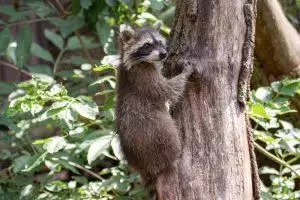
Normal climbing behavior or a sign of a nearby den
Why Raccoons Climb Trees
Raccoons are strong climbers. They may climb a tree to rest, avoid people or dogs, reach food, travel between properties or enter a hollow cavity. A raccoon seen in a tree does not automatically need to be removed.
The location and pattern of activity matter. A raccoon repeatedly using the same tree beside a roof, chimney, deck or outbuilding may be following a regular travel route. A hollow tree can also serve as a den, including a site for a female with young.
Professional service is more appropriate when tree activity is connected to structural entry, repeated property damage, a den in an unsafe location or a raccoon that cannot leave safely.
What the animal may be doing
Common Reasons a Raccoon Is in a Tree
Resting or avoiding a threat
A raccoon may remain on a limb or in a fork after being startled by people, dogs, traffic or daytime activity.
Using a hollow tree as a den
Cavities in mature trees can provide shelter for adults and young raccoons.
Traveling toward a roof or chimney
Branches near a house can provide access to roof edges, soffits, vents and chimneys.
Feeding nearby
Fruit, bird seed, pet food, trash and garden produce may keep raccoons returning to the same tree and yard.
Repeated tree use may reveal a structural route
Raccoons in Trees Near Homes and Buildings
A tree close to a house can function like a ladder. Branches may place a raccoon beside a roof return, soffit, attic vent or chimney cap. Muddy prints, claw marks, droppings or repeated camera activity may confirm the route.
Trimming a branch alone will not solve an active attic or chimney problem. The animal, possible young and confirmed building entry must be addressed before exclusion work is completed.
Give a passing raccoon space to leave
Do not shake the tree, throw objects, climb after the raccoon or allow dogs to remain below it.
Reduce activity around the tree and provide a clear route away when it can be done safely.
Determine whether the issue is temporary or established
How Raccoon Tree Activity Is Evaluated
- Observe the behavior from a distance. Note whether the raccoon is resting, entering a cavity, climbing toward a roof or being held in place by people or pets.
- Check the surrounding property. Trash, bird seed, pet food, fruit trees, decks and outbuildings may explain repeated visits.
- Inspect nearby structural access. Roof edges, soffits, vents and chimneys should be checked when the tree provides a direct route.
- Consider young raccoons. A hollow tree or nearby structure may contain dependent young even when only one adult is seen.
- Choose the appropriate response. A passing animal may only need space, while denning, damage or structural entry may require removal and exclusion.
Tree and Property Conditions That Encourage Activity
- Branches touching or overhanging roofs
- Hollow trunks and large tree cavities
- Fruit- or nut-producing trees
- Bird feeders and spilled seed
- Trash cans, compost and outdoor pet food
- Decks, sheds and outbuildings near tree cover
Daytime tree activity is not automatically abnormal
A raccoon may remain visible after being disturbed, while nursing young or after taking shelter during daylight.
Concern increases when the animal appears injured, cannot leave, repeatedly approaches people or is linked to building entry.
When tree activity becomes a service problem
When a Raccoon in a Tree Needs Professional Attention
A healthy raccoon temporarily resting in a tree may leave when the area becomes quiet. Professional service becomes more appropriate when the animal is denning in an unsafe location, repeatedly using the tree to enter a building, damaging property or remaining trapped by surrounding activity.
- Repeated climbing from the tree onto a roof
- Activity near a damaged soffit, attic vent or chimney
- A mother and young in a hazardous tree cavity
- Raccoons repeatedly feeding around the same tree
- An animal that appears injured or unable to leave
- Tree activity accompanied by attic sounds, droppings or damage
Connect tree activity to the likely property problem
Raccoon Tree and Removal Links
Questions about raccoons in trees
Raccoons in Trees FAQ
Why do raccoons climb trees?
They may use damaged vents, weak soffits, fascia gaps, roof intersections, uncapped chimneys or openings near additions and attached garages.
Should I shake the tree or scare the raccoon down?
No. Young raccoons may still be inside, and the adult may return. The active situation should be evaluated before permanent closure.
Can a tree help raccoons get into an attic?
Repellents, lights and noise do not reliably solve a structural raccoon problem. The animal, possible young and entry points must be addressed.
When does a raccoon in a tree need professional help?
Include the full property address, when the sounds occur, where they are loudest, any sightings, odor, and safe photographs of exterior roof or soffit damage.
Request service
Request an inspection for recurring raccoon activity
Please complete our contact form below:
Include the property address, how long the raccoon has been using the tree, whether it enters a cavity or roof, nearby pets, any structural damage and safe photographs or camera footage. For an immediate conversation during normal business hours, call (804) 457-2883.
Virginia Professional Wildlife Removal Services, LLC • (804) 457-2883 • vawildlifepro@gmail.com