Identify raccoon droppings and contamination areas
Raccoon Scat
Learn how raccoon droppings, repeated latrine sites, odor and contaminated attic or crawl-space areas can reveal an active raccoon problem and when professional cleanup should be considered.
Licensed and insured • Residential and commercial service • Serving Virginia since 2008
Droppings can reveal repeated activity and denning
What Raccoon Scat, Droppings, Poop and Feces Can Tell You
Raccoon scat—also commonly called raccoon droppings, poop or feces—is often dark, tubular and blunt-ended. Size, color and contents can vary with diet and age, and the material may contain seeds, fruit, insects or other food remnants.
More important than appearance alone is the location. Raccoons commonly return to the same places to defecate, creating repeated latrine sites on roofs, decks, tree bases, woodpiles, attics, crawl spaces and other protected areas.
Finding raccoon poop or feces inside a structure usually means raccoons have had access to that space. The active animal problem and the contaminated area should be evaluated together.
Appearance, location and repeated use
What Raccoon Droppings Look Like
Tubular raccoon poop with visible food material
Raccoon droppings may contain seeds, berries, insect parts or other recognizable food remains, depending on what the animal has been eating.
Repeated piles of raccoon feces in one location
A latrine site may build up over time because raccoons repeatedly return to the same area.
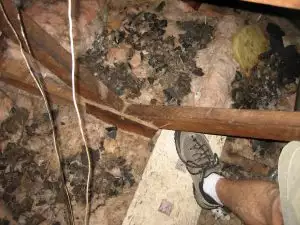
Droppings in attics or crawl spaces
Scat inside a structure may be accompanied by urine staining, nesting material, odor, disturbed insulation or other signs of occupancy.
Outdoor latrines near travel routes
Common locations include decks, roofs, tree bases, woodpiles, sheds, fence lines and areas near food sources.
Indoor contamination requires more than identification
Raccoon Latrines in Attics, Crawl Spaces and Other Structures
In an attic, raccoon scat may be concentrated near nesting areas, roof entries or travel paths. In a crawl space, it may appear near foundation openings, ductwork or protected corners.
Droppings may also be found on flat roofs, porches, decks, sheds and other elevated or sheltered surfaces. A single dropping does not always prove a den site, but repeated accumulation strongly suggests regular use.
Do not sweep or handle dry scat casually
Avoid direct contact, dry sweeping and unnecessary disturbance. Keep children and pets away from contaminated areas.
If the droppings are inside a structure, the active raccoon entry problem should be addressed before cleanup is completed.
Identify the source before planning cleanup
How Raccoon Scat and Contamination Are Evaluated
- Confirm the likely animal. Shape, size, contents, location, tracks and nearby damage help distinguish raccoon scat from other droppings.
- Determine whether the site is active. Fresh droppings, repeated accumulation, odor and current animal activity matter.
- Inspect for structural entry. Attic, roof, chimney, crawl-space and foundation access should be checked where appropriate.
- Remove or exclude active raccoons. Cleanup alone will not solve a continuing entry problem.
- Plan cleanup based on access and contamination. The amount, location and condition of affected materials determine the scope of work.
Common Raccoon Latrine Locations
- Attic insulation and roof-adjacent areas
- Crawl spaces and foundation corners
- Flat roofs, chimneys and roof intersections
- Decks, porches and elevated platforms
- Tree bases, stumps and woodpiles
- Sheds, barns and areas near trash or pet food
Not every dropping confirms an active den
Outdoor scat may come from a raccoon passing through, while repeated indoor accumulation usually indicates ongoing or previous structural access.
Freshness, location and other evidence should be considered together.
When droppings become a service problem
When Raccoon Poop, Feces or Droppings Need Professional Attention
Outdoor raccoon poop in an isolated location may only require careful avoidance and cleanup. Professional service becomes more appropriate when droppings are inside a structure, cover a large area, return after cleanup, or are associated with active raccoon entry, odor or damaged insulation.
- Repeated raccoon droppings in an attic or crawl space
- Raccoon feces near a chimney, roof entry or soffit opening
- Contaminated insulation or nesting material
- Strong odor or urine staining
- Children or pets regularly using the affected area
- Fresh raccoon poop appearing after previous cleanup
Match contamination to the likely entry area
Raccoon Scat and Removal Links
Questions about raccoon droppings and latrines
Raccoon Scat FAQ
What does raccoon poop look like?
They may use damaged vents, weak soffits, fascia gaps, roof intersections, uncapped chimneys or openings near additions and attached garages.
What is a raccoon latrine?
No. Young raccoons may still be inside, and the adult may return. The active situation should be evaluated before permanent closure.
Does raccoon poop in an attic mean raccoons are still there?
Repellents, lights and noise do not reliably solve a structural raccoon problem. The animal, possible young and entry points must be addressed.
Should the raccoon problem be fixed before cleanup?
Include the full property address, when the sounds occur, where they are loudest, any sightings, odor, and safe photographs of exterior roof or soffit damage.
Request service
Request an inspection for raccoon scat
Please complete our contact form below:
Include the property address, where the raccoon scat, poop, feces or droppings are located, how much is present, whether it appears fresh, any odor and any visible roof, chimney, crawl-space or foundation entry. For an immediate conversation during normal business hours, call (804) 457-2883.
Virginia Professional Wildlife Removal Services, LLC • (804) 457-2883 • vawildlifepro@gmail.com